South Africa is a country of contrasts: ancient and modern; traditional and contemporary; affluent and poverty stricken; spectacularly beautiful and shockingly shabby; thrilling and
complacent; dangerous yet comfortable, always somewhat surprising.
Just 16 years since the end of Apartheid with such recent memories of those gross injustices, I was surprised with the pervasive feelings of hope and with the apparent lack of residual anger.
The land and the weather are spectacularly beautiful and one feels a strong national pride from every level and person in society!
In South Africa of today there are many possibilities for thrills: going on safari, shark cage diving, mountain climbing, repelling, rigorous hiking and biking, parasailing, and more. Students and faculty alike enjoyed these physical activities while at the same time getting to know the real people of South Africa, both in the central city "bubble of affluence" and in the townships surrounding the city. It was common to hear that "we needed more days in South Africa!"
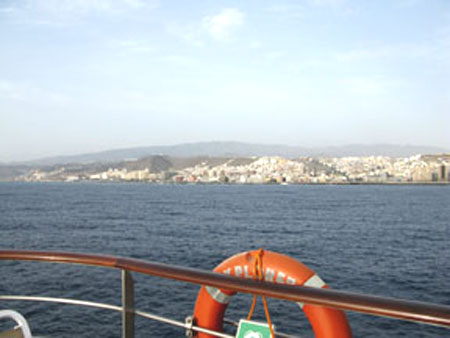
 First daylight view of Cape Town on arrival.

Sunset over Cape Town from the Voyager deck

In downtown Cape Town on the first morning in port, as we walked through the government center and the Company Gardens, I had to keep reminding myself - "this is South Africa!" I kept getting visual/sensory "hits" of Sacramento CA and/or Seattle WA!

Ancient sculptures and actual cave paintings on large slabs of rock are among the many splendors at the Natural History Museum in the Company Gardens.

 An Aloe tree in the central city Company Gardens.


 The National Flower is the lovely Protea


 An Aloe tree in the central city Company Gardens.

 The National Flower is the lovely Protea
The Voyager docked at the lively Harbor area where the upscale Victoria and Alfred shopping mall is located - so, of course, we shopped! In addition there were restaurants indoor and outside, street musicians, ice cream booths, craft markets and plenty of souveniers to buy.

On Safari: Bouncing and jostling and clinging onto the sides, we rode out into the vast game reserve of Hluhluwe searching for elephants, buffalo, Wildebeste (Gnu), kudu, baboons, zebra, rhinos, and the big cats. It was sometimes cold and
sometimes wet and always exciting.


On safari: The thrill of "the hunt" is unexpected... after all, we've all been to the zoo before! But in the wild bush of Africa, the safari experience is remarkable. Riding in the Land Rover, hushed when sighting animals, startled when suddenly around a corner there is an elephant or a giraffe in the road, straining eyes to see more - it is all very thrilling. Though we saw evidence of the large cats in their fresh footprints or feces, my group did not sight any lions, leopards, nor cheetahs.


 We searched and searched for elephants then finally in the afternoon we had many sitings including this fellow who was busy pushing down the tree (right onto our vehicle had our driver not quickly moved away!) in order to get to the tasty new spring leaf growth that was out of his reach. This was an exciting moment!

 Quazulu Natal is the homeland in South Africa


 We searched and searched for elephants then finally in the afternoon we had many sitings including this fellow who was busy pushing down the tree (right onto our vehicle had our driver not quickly moved away!) in order to get to the tasty new spring leaf growth that was out of his reach. This was an exciting moment!

 Quazulu Natal is the homeland in South Africa
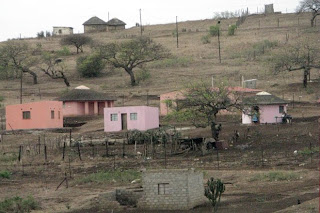
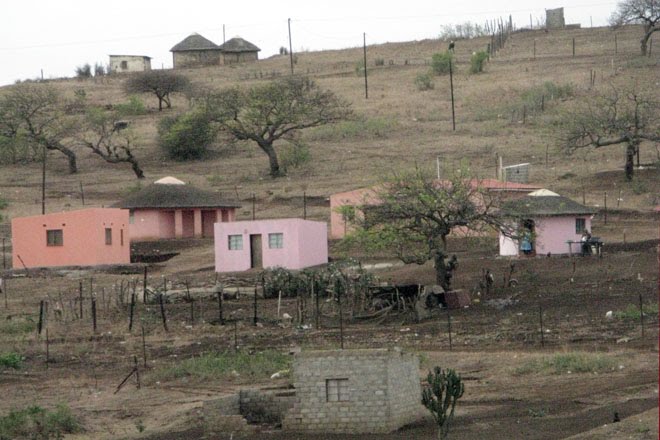
of the Zulu people who frequently live today in the traditional extended family home settlements, each with their respective cattle herds. Marriage contracts are settled when the man pays 11 - 21 cattle to the woman's family.
Zumma, the current President of South Africa is a Zulu and is just marrying his third wife, with contracts in the works for two more for next year and the year after.


A hunt of a different sort at a Zulu Market where
many Zulu foods and produce were available for sale.


We stayed at the Zululand Lodge under the Fever trees in Kwazulu Natal near Hluhluwe National Game Reserve. The food was wonderful, the ambience perfectly safari, and there was even a tremendous thunder and lightning storm which took out the power so we were candle lit - even in the thatched-roof huts! In the evening light of the generators after the big storm there was a hatching of Flying Ants (by the thousands ... and thousands!!!!) which were way too many for me!!! I scooted back to the 'safety' of the netted bed shelter within the cabin. Yikes!


Before we left Cape Town, I led a tour to Africa Allsorts which is a small business employing wire and bead street artists making beaded African animals and allsorts of other things. Prior to the current global economic crisis these beaded sculptures were high-end exports world wide. We interacted with the bead and wire artists and each made a small piece of bead work.